
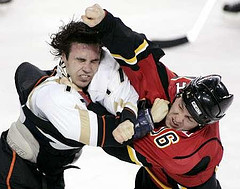
 I’ve often said to my hockey-mad son Ben that we could end on-ice fighting in hockey (not, incidentally, our national sport, but arguably our Canadian obsession) if only the National Hockey League would put me in charge for just one week. But the folks who do run the NHL clearly have no appetite for banning hockey fighting, or they would have acted to end it by now.
Despite their feeble protests about the unacceptability of fighting and the known dangers of career-ending concussions, team owners tolerate cheap shots by beefy goons who spear, hit, and drop their gloves to fight. The League accepts it, the owners accept it, the players accept it, and the fans apparently love it.
There is, alas, no organizational will to ban violence on the ice.
And much like hockey goons, medical journal editors could end the appallingly unethical and dangerous practice of medical ghostwriting in one week, but these editors clearly have no appetite for banning ghostwriting in their journals, or they would have acted to end it by now.
There is, alas, no organizational will to ban medical ghostwriting. Continue reading
 Let’s not pop the champagne corks just yet to celebrate the recent announcement of new guidelines for Big Pharma from the trade group
  Drug giant Merck & Co. is paying the families of more than 3,100
  Participants at this month’s
  Just when we thought things couldn’t get any more slimy in the wonderful world of Big Pharma-funded medical journal articles, along comes last week’s editorial in the Canadian Medical Association Journal. Their September 9th editorial claims that somewhere between 50% and 100% of articles on drugs that appear in journals are ghostwritten, according to
  Here’s one possible solution to the fraudulent practice of medical ghostwriting that seems so easy, I’m wondering why all medical journal editors are not already doing it, given the current bad press garnered by the Wyeth Pharmaceuticals
  The Ethical Nag