
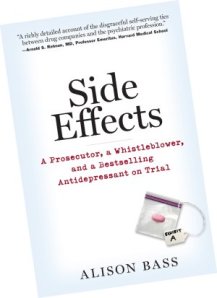
 Here’s more this month from investigative journalist Alison Bass, author of the book Side Effects: A Prosecutor, a Whistleblower, and A Bestselling Antidepressant on Trial:
“The same drug giants paying millions of dollars to settle claims that they engaged in illegal and improper marketing of anti-psychotic drugs in the U.S. are even now looking for new worlds to conquer. Consider the study published in the Archives of General Psychiatry. It surveyed more than 60,000 adults in 11 countries in Eastern Europe, Asia and South America and concludes that the treatment needs for people with bipolar disorder are “often unmet, particularly in low-income countries.”
“That may indeed be true. But I’d find this result a lot more believable if the study were not funded in large part by the same pharmaceutical companies who make the atypical anti-psychotics used to treat bipolar disorder: Eli Lilly (which makes Zyprexa), Janssen (the unit of Johnson & Johnson that brought us Risperdal), Pfizer (Geodon), Bristol Myers Squibb (Abilify), GlaxoSmithKline (Lamictal), and Novartis (Fanapt). Continue reading
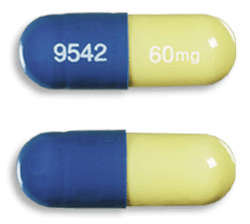 Drug companies are acutely aware of what’s called the ‘patent cliff’, when their expensive brand name medications lose their patent protection, thus opening up the market for cheaper, identical generic competition. This is good news for consumers, but very bad news for Big Pharma.
  When I visit my friend Ruth in her nursing home, I have to walk down a long corridor to get to her room. Along one wall of the long corridor sits a large aquarium. In front of the large aquarium, wheelchairs are lined up every day, eight or nine in a row facing the fish, their occupants slumped in semi-conscious stupor, rheumy eyes half-closed or glazed, with none of them paying any attention to the fish. It is distressing to me, this row of seniors. It reminds me that every one of them was once young and healthy.
 Since returning from
 The Ethical Nag