
 “Judges do not hear cases in which they have a financial interest. Reporters do not write stories about companies in which they have a financial interest. By the same token, doctors should not have a financial interest in treatments they are evaluating, or accept gifts from the makers of drugs they prescribe.”
That’s what Dr. Marcia Angell says, and she ought to know. She spent over 20 years as editor of the prestigious New England Journal of Medicine. She wrote these words last January in a letter to Dr. Nada Stotland, president of the American Psychiatric Association in response to Stotland’s criticisms of her essay in the New York Review of Books.
Back then, the editorial board at the New York Times had decreed:
“The medical profession needs to wean itself almost entirely from its pervasive dependence on industry money.”
Dr. Angell agreed with the Times, adding:
“Pervasive conflicts of interest corrupt the medical profession, not in a criminal sense, but in the sense of undermining the impartiality that is essential both to medical research and clinical practice.”
Dr. Angell disagreed strongly with psychiatrist Dr. Stotland’s assertion that very few drugs of any kind have been tested on children. Not so, claims Dr. Angell. Continue reading
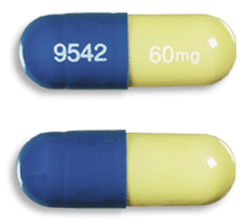 Drug companies are acutely aware of what’s called the ‘patent cliff’, when their expensive brand name medications lose their patent protection, thus opening up the market for cheaper, identical generic competition. This is good news for consumers, but very bad news for Big Pharma.
  When I visit my friend Ruth in her nursing home, I have to walk down a long corridor to get to her room. Along one wall of the long corridor sits a large aquarium. In front of the large aquarium, wheelchairs are lined up every day, eight or nine in a row facing the fish, their occupants slumped in semi-conscious stupor, rheumy eyes half-closed or glazed, with none of them paying any attention to the fish. It is distressing to me, this row of seniors. It reminds me that every one of them was once young and healthy.
 Let’s say you are a heart attack survivor like me, who must now take a fistful of cardiac drugs every day. And let’s say one of them is
  Since returning from
  The Ethical Nag